
Five things that matter from the West Midlands Growth Summit
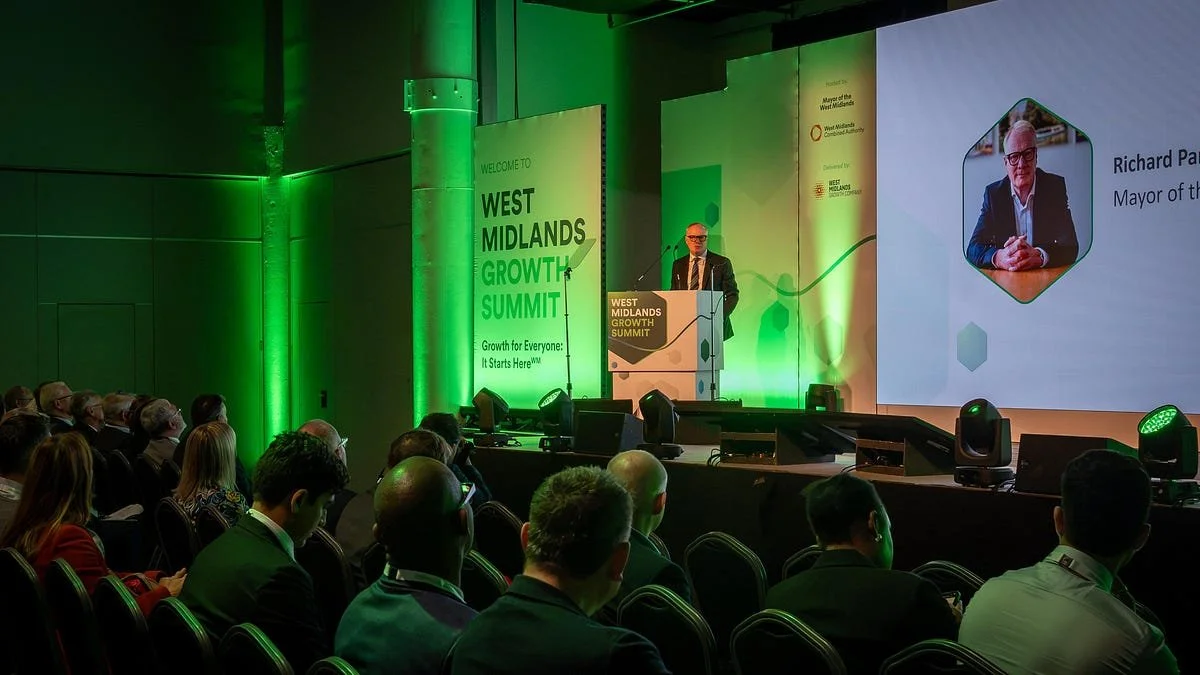
Last week's West Midlands Growth Summit brought together Government, investors, developers and business leaders to set out the next phase of the region's economic growth.
There was no shortage of ambition, with substantial announcements on investment, infrastructure and the partnerships needed to turn the region's growth plans into reality.
Here's what stood out.
1. The West Midlands is leading the reindustrialisation agenda
Richard Parker launched the West Midlands Reindustrialisation Blueprint, putting advanced manufacturing, innovation, skills and industrial competitiveness at the heart of the region's economic strategy.
It's the first of its kind in the UK and is backed by new initiatives including £18.4 million for business energy efficiency, a Battery Manufacturing Taskforce and support for workers affected by recent changes at Jaguar Land Rover.
This is significant for developers and investors. Employment land is increasingly being measured by its contribution to productivity, supply chains and high-value industries.
The challenge now is ensuring the region has the sites, power, infrastructure and skills to turn that strategy into reality.
Read more about the Reindustrialisation Blueprint
2. Birmingham Airport has a £2 billion growth ambition
Birmingham Airport unveiled its draft Master Plan, proposing £2 billion of investment over the next 15 years to accommodate around 30 million passengers annually.
The Airport estimates this could generate an additional £3.6 billion in regional economic output and support more than 50,000 jobs.
For the wider UK Central area, the implications are substantial. Airport expansion, HS2 Interchange, Arden Cross, the NEC and surrounding employment locations collectively represent one of the country's most significant growth opportunities.
The opportunity now is to ensure these investments are coordinated, creating a connected economic destination rather than a collection of individual developments.
Read Birmingham Airport's announcement
3. The £3.8 billion Futures Fund is open for business
Perhaps the most significant announcement for developers was the opening of the West Midlands Futures Fund to private-sector expressions of interest.
The £3.8 billion fund brings together public and institutional capital, with around £545 million currently allocated to commercial, mixed-use and large-scale residential investment opportunities.
Developers can now submit projects for consideration, with the ambition of unlocking sites, attracting private capital and accelerating delivery.
The real test will be how quickly that funding translates into investment decisions, infrastructure and construction starts.
Explore the Futures Fund opportunity
4. Warwick and Imperial have a new Scale-up Pathway
A new Scale-up Pathway, led by the University of Warwick and Imperial College London, will connect the West Midlands' advanced manufacturing capabilities with West London's research, technology and innovation ecosystem.
The ambition is to help British businesses move from research and development into commercial production, with access to investment, talent, specialist facilities and supply chains.
With HS2 set to connect Old Oak Common and Birmingham, the partnership also highlights the potential for stronger links between the UK's research and manufacturing economies.
Read about the Scale-up Pathway
5. Digbeth's creative economy is anchoring long-term regeneration
The Summit also provided a platform for the announcement that Homes England has selected Digbeth Loc. Studios Ltd as preferred development partner for Fazeley Street, subject to contract.
The opportunity builds on the success of Digbeth Loc. Studios, the BBC's investment at Typhoo Wharf and the wider creative community already established in Digbeth.
Alongside WMCA's wider commitments to creative industries, it demonstrates that film, television and cultural production are increasingly being recognised as engines of economic growth and regeneration.
For Birmingham, the opportunity is to build a genuinely distinctive creative quarter, supporting new businesses, attracting investment and creating opportunities for local talent.